Showing posts with label World. Show all posts

Saturday, September 12, 2015

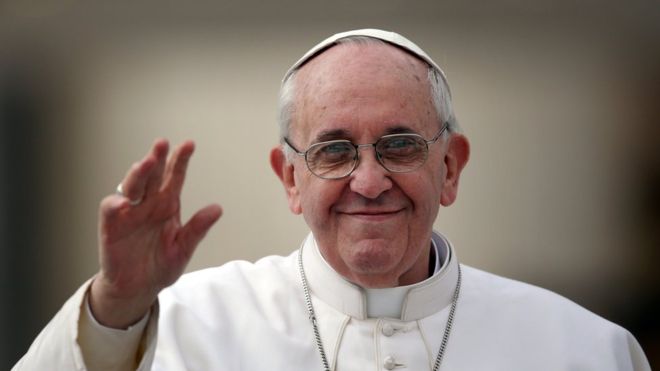
Pope Francis makes it easier for Catholics to remarry


Pope Francis has unveiled reforms intended to make it easier for Roman Catholics to get annulments and remarry within the Church.
Catholicism does not recognise divorce and teaches marriage is a lifelong commitment.
In order to separate, Catholics must have their marriage annulled by showing it was flawed from the outset.
The radical reforms allow access to procedures free of charge and fast-track decisions.
Until now the procedures have been seen as arcane, expensive and bureaucratic.
Catholics seeking an annulment previously needed approval from two Church tribunals. The reforms will reduce this to one and remove the requirement of automatic appeal. An appeal will still be possible if one of the parties requests it.
The new fast-track procedure will allow bishops to grant annulments directly if both spouses request it.
Because annulment procedures are complicated, couples normally require experts to guide them through, meaning that gaining one can be expensive.
Without an annulment, Catholics who divorce and marry again are considered adulterers and are not allowed to receive communion.
Last year, the Pope set up a commission of church lawyers and clerical experts to look at how to streamline the procedure.
Writing about the changes, Pope Francis said it was unfair that spouses should be "long oppressed by darkness of doubt" over whether their marriages could be annulled.

Caroline Wyatt, BBC Religious Affairs Correspondent

It was a pope's refusal to grant King Henry VIII an annulment of his marriage to Catherine of Aragon in the 16th Century that led to England's break with Rome and the creation of the Church of England, with the monarch as defender of the faith.
In the intervening centuries, the process of obtaining an annulment for ordinary Catholics has remained a lengthy and costly one.
The move by Pope Francis to simplify and streamline the process has come to fruition unusually quickly for the Vatican.
It's only a year since he set up a commission of Church lawyers to look at reforms to the process.
While they're not expected to change Catholic teaching on divorce, they are likely to make it easier for estranged couples to prove that their marriage was invalid from the beginning.

Friday, September 11, 2015

Turkey's pro-Kurdish HDP party offices attacked in Ankara


A crowd has attacked the headquarters of Turkey's pro-Kurdish HDP party, amid rising violence between Turkish forces and the militant Kurdish PKK group.
Pictures from the scene appeared to show the HDP building in the capital, Ankara, on fire.
Prime Minister Ahmet Davutoglu has appealed for calm.
Earlier, Turkish ground forces crossed into Iraq in pursuit of Kurdish militants for the first time since a ceasefire with the PKK two years ago.
Turkish warplanes also launched a wave of air strikes on bases of the PKK (Kurdistan Workers' Party) in northern Iraq.
Nationalists staged rallies across Turkey on Tuesday, hours after 14 police officers were killed in a suspected PKK bomb attack on a minibus in the east of the country.
The bombing came a day after another militant attack on the Turkish military killed 16 soldiers.

Newspaper attacked

HDP (Peoples' Democratic Party) lawmaker Garo Paylan told Reuters news agency that hundreds of protesters had attacked the building in Ankara.
"Police are just watching, he said. "What's being broken there is our hope of living together."
HDP offices in at least six other Turkish cities were reported to have been attacked and images on social media appeared to show those in the southern resort city of Alanya also on fire.
In Istanbul, pro-government protesters again attacked the offices of the Hurriyet newspaper, smashing windows. An angry crowd had stormed the building on Sunday accusing the newspaper of misquoting President Recep Tayyip Erdogan in a TV interview.
Mr Davutoglu took to Twitter to denounce the attacks.
"It is unacceptable to damage media institutions, political party buildings and the property of our civilian citizens," he said.
"I invite all my citizens with hearts full of love for the country to calm, embrace one another, and to have confidence in the state."
HDP leaders have accused Mr Davutoglu's governing AK Party (AKP) of stoking unrest to drum up nationalist support ahead of elections on 1 November.
The HDP entered parliament for the first time in June elections and its 14% share of the vote deprived the AKP of a parliamentary majority.
The surge in violence follows the collapse of a ceasefire in July between the Turkish army and the PKK.
The truce, which began in 2013, unravelled after a suicide bombing by suspected Islamic State militants near the border with Syria. The attack led to mutual recriminations between Kurdish groups and Turkey.
Earlier on Tuesday, Turkey's Dogan news agency said two special forces units, supported by warplanes, had entered northern Iraq and attacked two groups of militants.

Thursday, September 10, 2015

Migrant crisis: Are world powers failing to act?


The biggest powers in the world were not able to find a way to stop the war in Syria when it broke out in 2011.
More than four years on, a whole new set of challenges is coming from Syria, and other countries in the Middle East and Africa. And the world's biggest powers are struggling once again to find answers that work.
The new crisis is about refugees. The European Union is discovering, belatedly, that it is impossible to avoid the consequences of a range of wars and civil conflicts right next door.
Some Western politicians, and journalists, are taking proper notice for the first time of a refugee crisis that has been a huge concern for Syria's neighbours since the war started.
The difference now is that refugees, in big and increasing numbers, are trying to get to the richest countries in Europe.
The EU is discovering that the Mediterranean is an inadequate moat. Eventually a response will be found to handle this summer's refugees.

Yarmouk example

But the fundamental reason why they will continue to come is still there.
And that is war in Syria, in Libya, in Iraq and Yemen. Violence, instability and chaos make lives miserable, dangerous and short across a broad swathe of the Middle East and Africa. It is not surprising that people want to get out.
Some may not have their lives threatened directly, but they want to leave before the worst happens.
People do not leave their homes lightly. They flee, and sometimes take dreadful risks at the hands of people smugglers, because the alternatives are so much worse.
I walked through the ruins of Yarmouk, one of the most fiercely contested battlegrounds in Damascus, only a few miles from the centre of the city.
Yarmouk used to be a Palestinian refugee camp for families who had fled or been driven from their homes when Israel won its independence war in 1948.
Over the last three years in Damascus I have spent nights watching Yarmouk being pounded. On the day I was there, it was quiet and eerie.
The Syrian army and Palestinian fighting groups control roughly half of Yarmouk. All the civilians who lived there have gone. Some are in shelters nearby. Some are trying to get to Europe.
Street after street was in ruins. Every building was damaged, not just by artillery but by thousands of rounds that were fired in street fighting.

Wednesday, September 9, 2015

Migrant crisis: Who does the EU send back?


For months now Europeans have been witnessing chaotic scenes of migrants pouring into Greece, Italy and Central Europe.
The EU is playing catch-up, struggling to co-ordinate asylum policy between 28 member states.
But it is a sensitive issue, affecting sovereignty and national relations with diaspora communities, such as Afghans in the UK, or Algerians in France.
The UK and Ireland opted out of most EU asylum policy, sticking to their own rules.
The focus now is on a mechanism to distribute new asylum seekers across the EU - but countries are arguing over that.
Many will qualify as refugees - especially those who fled Syria, Afghanistan or other conflict areas. A refugee is someone fleeing war or persecution, with a right to international protection.
But how many failed asylum seekers are sent back by EU countries? Is there any EU-wide pattern on asylum?

Identity checks

In 2015 the largest migrant groups in Europe by nationality are Syrians, followed by Afghans, then migrants from Eritrea, Nigeria and Somalia.
War and human rights abuses have plagued all those countries, so many of those asylum seekers count as refugees.
But each case is different - some will find it harder than others to prove their refugee credentials.
Many lack passports or other ID, having risked their lives in the Mediterranean and Balkans, abused and exploited by criminal gangs.
Establishing nationality can be a long process - and those decisions can be disputed by countries asked to take migrants back.
Many migrants reaching the EU from sub-Saharan Africa or the western Balkans fail to get asylum, as they are classed as economic migrants.
One of the incentives for irregular migrants is the fact that fewer than half of failed asylum seekers are actually expelled.
In 2013 the EU sent back just 39% of those refused asylum, the EU Commission says in its European Agenda on Migration.
Another stumbling block is that agreements with non-EU countries on asylum returns are quite patchy.
Many readmission agreements have been negotiated, for example with Pakistan and Bangladesh. But the EU has no such deal with China or Algeria.
And the Cotonou Agreement, obliging sub-Saharan African countries to take back failed asylum seekers, has not stopped a huge exodus of economic migrants from there. The Commission admits that the EU must offer more aid, to facilitate more migrant returns to Africa.
There are also plans to widen the mandate of Frontex, the EU border agency, so that it can help send migrants back.

Tuesday, September 8, 2015

The Paris school occupied by hundreds of migrants


The unauthorised occupation by migrants of a Paris secondary school is focusing minds on how the country will cope if the current inrush of asylum seekers accelerates.
The Lycee Jean Quarre in the multi-ethnic 19th arrondissement was taken over at the beginning of August. Today it houses around 300 asylum seekers and economic migrants mainly from Sudan, Afghanistan and Eritrea. These are people who before were sleeping rough or in tents on the street.
The place is not exactly salubrious. The school had actually been decommissioned and was sitting empty. The building is in the main sound, but there are dripping ceilings and the electricity cuts out intermittently.
The migrants sleep on mattresses about 20 to a room. They do their best to keep it clean, but it is bare and dingy. Outside in the yard, the young men play basketball, football and cricket.

Calais route 'dangerous'

Tanguy Lyonnet of the collective La Chapelle en Lutte (The Struggle of La Chapelle) told me that there was a big turnover at the school. Few stay long.
"Some people move out to better accommodation provided by the official associations. Others want to move north - to Calais. But this we strongly advise against," he says.
Why? "Because the camp there is not safe; and because people get killed trying to cross to the UK."
This is interesting because it shows how the people who advise the migrants are unwittingly pursuing British policy by discouraging people from taking the Calais route.

"But we are not doing it to help the British government," Mr Lyonnet makes clear. "We are doing it because it is what is best for the migrants."
Few of the people at the lycee speak any English. Fewer speak French, though lessons are being given. One group of Sudanese men was poring rather sadly over an exercise book full of conjugated verbs.
What struck me most though was how unenthused people were by their experience in France. A lot appeared to have bought into the "Home of Human Rights" idea of France, and now felt somewhat disabused.
A Sudanese man said: "I actually wanted to come to France, because I always liked the idea of France. But now I am here I have changed my mind."
For the city authorities, the school occupation was an embarrassment that they cleverly dispelled by claiming it was their idea all along. There is clearly no love lost between the politicians at City Hall and the activists on the ground who helped in the takeover.
But now it is a fait accompli, Paris says it will turn the school into a semi-permanent migrant centre. Money will be spent making the building more liveable.
"Our policy is to be pragmatic and humanist," the city's deputy mayor Dominique Versini told me.
"So far I would say we have succeeded, but how things will be in three, four or six months - who can say? The problem is still ahead of us."
 

Magic Formula Investing Copyright © 2011 -- Template created by O Pregador -- Powered by Blogger